Scanning Pictures
November 28, 2025by: Felicia Duffy
The Greene County Historical Society
On February 27, 2026, a collection of artifacts were brought out from an underground tunnel connecting basements together at the Greene County Historical Society and Museum.
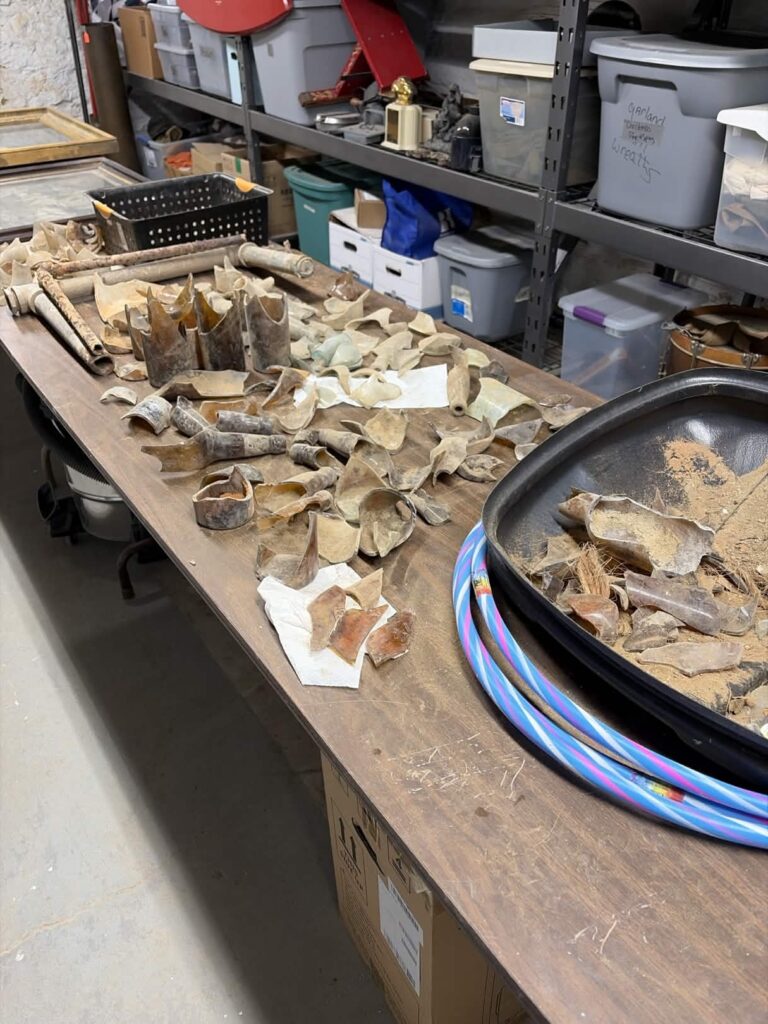
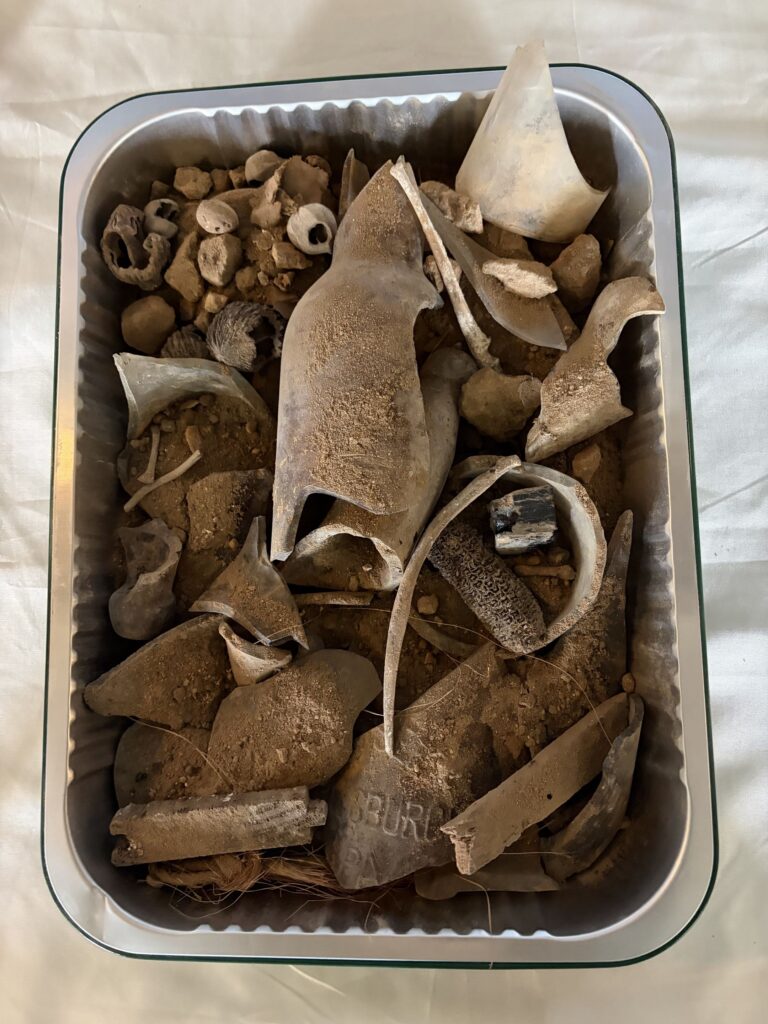
While cleaning up debris and throwing out spare, dead electrical wires, a pile of broken glass was found lying around the left corner next to one of the tunnel entrances. Covered in layers of dust and many shards buried under dirt, bins of the glass were carefully removed from the tunnel for the first time since the late 1880s.
The labels on the bottles included the following: I. Joseph Pittsburgh PA, E. P. Reed & Co Rochester N.Y, Raphael & Zeuschmidt Pittsburg Pa, and Schmul Bach Brewing Co Wheeling. All popular liquor brands during the 1880s. There were also medicine bottles, many walnut shells, corn on the cob remains, old paint buckets, can lids, and animal bones found throughout the tunnel. These artifacts tie directly to a period of expansion and hardship at the County Home.
As per G. Wayne Smith’s first volume of History of Greene County Pennsylvania, printed in 1996, “Established in a converted farmhouse in 1861, there were fifty-seven adults in the Home in January 1886, twenty-nine males and twenty-eight females.” The Alms County Home in Franklin Township was in “…operation of… the care of indigent adults.” It was a center for the county’s poor.
While visiting the grounds, Dr. A. J. Ourt, the secretary for the State Committee of Lunacy, said it was, “a den of bugs and vermin… the worst building in the state.” The building was described by an editor of The Waynesburg Republican as resembling a barn, not a house, with inadequate construction, making it “impossible to separate the old and young, the sane and insane, or even the sexes.“
From 1886 to 1887, commissioners had approved plans for additions to the building: a third story to the old building, two large two-story wings on the north and south, and a kitchen wing on the east for a total of around $50,000, which translates to over $1.60 million today. The north wing was never built. And the wing on the southern end is to this day referred to as the “West Wing.”
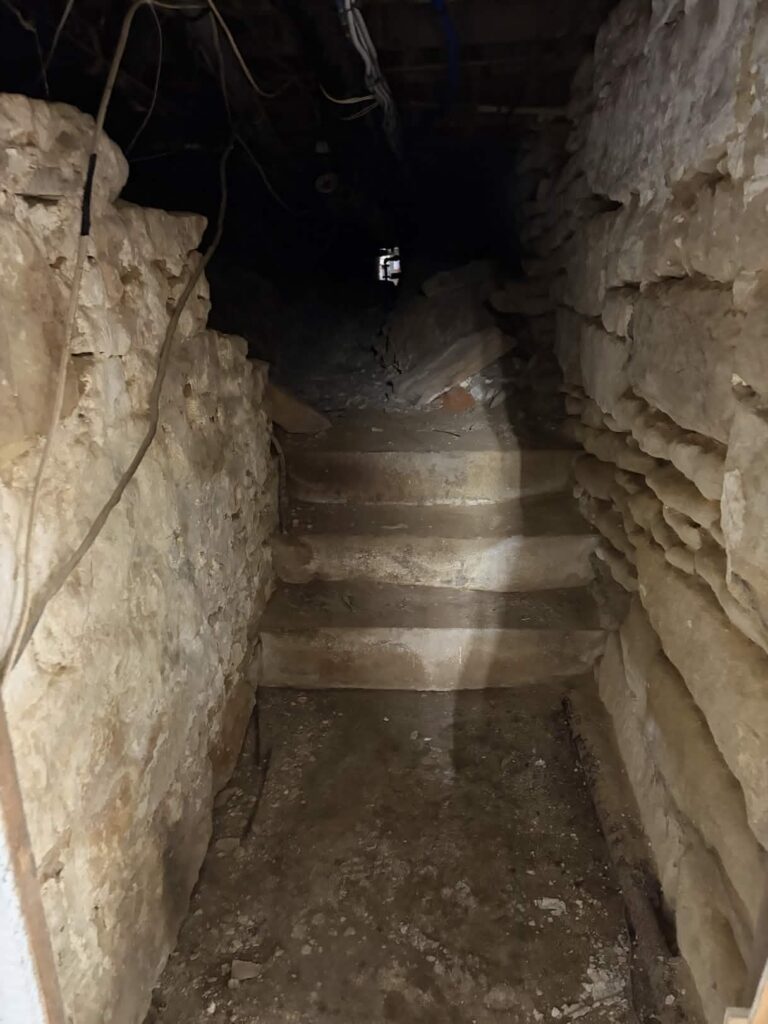
The digging process of these tunnels began as a trench. Located by the side, red door, there used to be an opening to get into this underground space. Workers entered and exited the area here, bringing resources in and out at the start of the digging operation.
Construction on the south side of the building for the West Wing was in process May 1, 1887. Steam pipe lines were needed to run from what is now the library into this additional building wing. The library’s initial construction, located behind the Alms House, was built as a place to run pipes and heat into radiators around the grounds, supporting the heating systems
It is believed the bottles found stashed in this trench were from the many workers tasked with digging the space. They were likely drinking on the job, tossing the empty glass into the corner where it cracked and was buried until recently. Also note the bricks above where the pile of bottles were uncovered is all beat up, destroyed from days of getting abused by glass.
While it is unknown what the original use of the basements were for, it is assumed the basement under the steward’s office and 1861 dining hall was a kitchen. Canning is implied to be a part of what was done there, seeing as stairs go straight from the basement into what was known as an inmate dining hall.
Renovations in 1889 further altered the building’s layout, transforming what had been a single long hallway with segmented interior with rooms on both sides into a larger inmate dining hall. This transformation made the steward’s parlor and kitchen grow in size, too.
The artifacts also echo a darker chapter in the site’s history. Contemporary accounts describe the County Home as overcrowded, unsanitary, and poorly managed.
From hazardous, inadequate meals, to whipped with a rope, beaten with tool handles, and cursed at, inmates were brutally beaten by Stewart William B. Cage. Beds were “unclean and filthy,” and clothing was worn out and “unfit for use.” A majority of walls and floors were decaying and giving off “a most disagreeable odor.”
These allegations of abuse further stained the institution’s reputation, with plenty of inmates living in fear. “The Waynesburg Republican in the form of an affidavit of John A. Kelly, who lived near the home and swore that he had witnessed several instances of Cage’s beating of inmates and said that inmates often came to his house to eat because they were hungry.”
Despite these conditions, the County Home served hundreds annually. Records indicate that 655 individuals received aid in 1890, rising to 670 in 1892, though the average daily population hovered around 60 residents.
Today, the newly uncovered artifacts offer a tangible connection to the laborers who built and lived in the facility. The GCHS will have some of the items cataloged and preserved in an exhibit. Community members are welcomed and encouraged to see these artifacts, and much more, during the last weekend in April, 2026, when General Admission reopens for the year.
As research continues, the tunnel and its contents may reveal further insights buried beneath more than a century of history.